
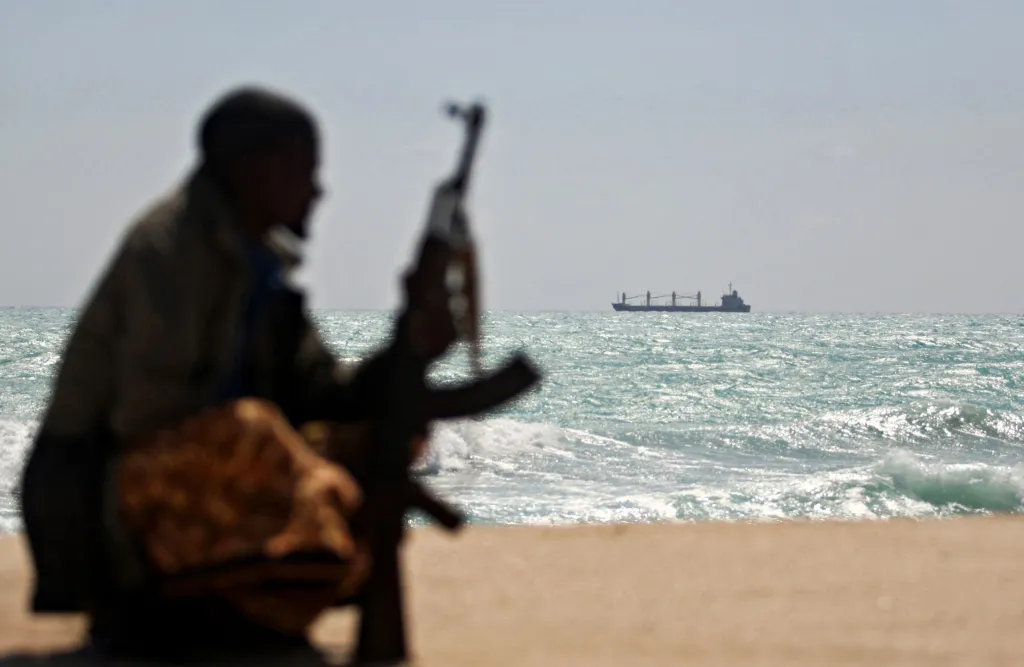
Somali pirates are stepping up attacks on commercial shipping, taking advantage of a security gap that opened up as naval forces shifted their attention toward the Iran war.
Since the conflict began in February, the United States and other international navies have concentrated ships and resources in the Persian Gulf, the Strait of Hormuz and the Red Sea, according to maritime security analysts. That buildup has left the Gulf of Aden and the wider western Indian Ocean, long a hotspot for Somali piracy, with comparatively thin coverage.
Pirates have moved quickly to exploit the opening. Six commercial vessels have been seized since April, including oil tankers and a chemical carrying ship hijacked in July. Maritime tracking groups have logged 41 incidents in the Bab el Mandeb Strait and the Strait of Hormuz as of Tuesday, and traffic through the Strait of Hormuz has thinned sharply, with fewer than 20 commodity vessels crossing over one recent weekend.
Brett Erickson, managing principal at the maritime risk firm Obsidian Risk Advisors, said the reduced naval presence has made piracy an increasingly attractive business for armed groups operating off the Somali coast. This is obviously a very, very lucrative business for them, Erickson said, noting that pirates now face a lower risk of drawing an American military response while global attention stays fixed on the Middle East.
The current wave is still far from the piracy crisis of 2005 to 2012, when attacks topped 1,000, ransom payments reached an estimated 400 million dollars, and the disruption to shipping cost the global economy an estimated 18 billion dollars a year. But the recent uptick has shipping companies and insurers watching closely, wary that a prolonged Iran war could leave the security gap open long enough for piracy off the Horn of Africa to climb back toward those levels.